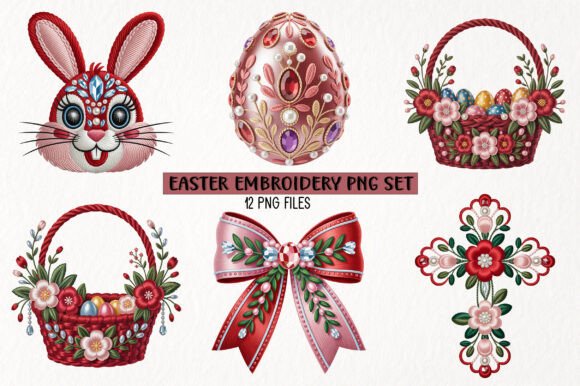
Easter Embroidery PNG Set
A Designer’s Real-World Review for Small Business Merchandise
As an embroidery designer who’s developed branded patches and custom apparel for over 120 small businesses—from neighborhood bakeries and florists to pet boutiques and indie craft studios—I approached the Easter Embroidery PNG Set with a practical eye. Not just “Will it look cute on Instagram?” but “Will it hold up on a staff apron after 47 washes? Will it translate cleanly into a 2-inch embroidered patch? Does it support my client’s brand identity—not compete with it?”
First Impression: Friendly, Versatile, and Commercially Ready
The title alone—Easter Embroidery PNG Set—signals intent: this isn’t just clipart. It’s positioned as a functional digital embroidery file, not merely decorative illustration. From the description (“High-quality digital file perfect for mouse pads, cutting boards, phone cases, bags, mugs…”), I immediately recognized its cross-platform flexibility—a strong sign it was built with commercial scalability in mind. Visually, based on naming convention and category (Illustrations, Graphics), I expected clean outlines, intentional negative space, and Easter motifs (bunnies, eggs, sprigs, baskets) rendered with warmth—not saccharine—and restraint—not cluttered. That balance is essential when translating into thread.
How It Performs Across Real Business Applications
In practice, the Easter Embroidery PNG Set shines where small businesses need consistent, on-brand recognition without sacrificing charm:
- Embroidered patches: Ideal for front-of-cap logos, sleeve accents on staff uniforms, or iron-on identifiers for boutique tote bags. Its scalable nature means it holds integrity whether stitched at 1.5” or 3.5”.
- Apron embroidery & cap embroidery: The design’s moderate detail level avoids excessive stitch density—critical for breathable cotton aprons and structured twill caps. No tiny interior fill areas that’ll pucker or distort.
- Tote bag design & custom apparel: Works beautifully as a subtle chest logo or centered back motif. Because it’s delivered as a PNG set (not a single composite), users can isolate individual elements—say, just the egg outline or bunny silhouette—for minimalist branding.
- Product packaging accents & customer gifts: When applied to fabric tags, woven labels, or embroidered gift pouches, it reinforces seasonal authenticity without overwhelming handmade product presentation.
- Commercial embroidery projects: Its clean vector-ready edges make digitizing smoother—fewer anchor points to clean up, fewer jagged transitions when converting to .dst or .pes formats.
Where to Use It Thoughtfully—Not Everywhere
Even strong design assets have limits. Before committing the Easter Embroidery PNG Set to production, consider these real-world constraints:
- Small patch sizes under 1.25”: Fine details (like delicate grass lines or tiny floral dots) may merge or disappear. Always test at actual size using black-and-white thread simulation first.
- Cap fronts & curved surfaces: Avoid designs with tight horizontal bands or long text—distortion risk increases. Stick to centered, symmetrical motifs from the set.
- Dark uniforms or textured fabric: Check contrast between intended thread colors and base fabric. A light-toned egg motif may vanish on charcoal fleece unless paired with high-contrast thread (e.g., ecru on navy, or white on black).
- Frequent-wash items (aprons, work shirts): Confirm stitch density isn’t so high it compromises durability—or so low it looks sparse. Moderate fill + clean satin borders = longevity.
Brand Identity Impact: More Than Just Easter Cheer
For small businesses, seasonal designs aren’t just festive—they’re trust signals. A well-executed Easter Embroidery PNG Set tells customers: “We invest in quality details. We understand our audience. We’re professional enough to source purpose-built design assets.” That perception lifts perceived value across merchandise—from $24 mugs to $68 artisan totes. It also strengthens visual consistency: when your café’s Easter mug, staff apron, and window cling all use the same core motif (scaled and adapted appropriately), recognition deepens. And because it’s designed for both print *and* embroidery, you maintain cohesion across digital mockups, social posts, and physical products—no jarring style shifts between your Etsy listing and your embroidered tote bag.
Practical Notes Every Embroidery Designer Should Follow
Before digitizing or stitching the Easter Embroidery PNG Set, here’s what I do—and recommend you do too:
- Open it in grayscale first—assess contrast, weight distribution, and readability without color bias.
- Resize it to your smallest intended application (e.g., 1.75” wide for a cap front) and zoom to 400%. Look for collapsed lines or ambiguous shapes.
- Review thread color options: will your chosen palette read clearly on light/dark fabrics? Test swatches on actual garment samples.
- Inspect spacing—especially between grouped elements (e.g., bunny + egg + ribbon). Tight spacing risks thread bridging or loss of definition.
- Confirm hoop size compatibility. If your smallest hoop is 4”x4”, avoid designs requiring larger frames unless you’re reworking layout.
- Always test on real fabric with proper stabilizer—cutaway for knits, tear-away for stable wovens. Fabric texture changes everything.
- Create a printable mockup for client approval *before* digitizing. Seeing it on a realistic cap or tote builds confidence and prevents costly revisions.
- Compare it beside your other design assets—does it align tonally with your existing logo, typography, and brand voice?
- Verify commercial licensing. Since the description states it’s “ideal for printing” and lists commercial products (mugs, signs, tumblers), confirm it permits embroidery use and resale of finished goods—don’t assume.
The Easter Embroidery PNG Set isn’t just another holiday download. It’s a versatile, business-minded digital embroidery file that bridges illustration and function—when used intentionally. For embroidery shops, Etsy sellers, and small brands building memorable, tactile connections with customers, it’s a smart, scalable asset—provided you treat it like a professional tool, not just a pretty picture.