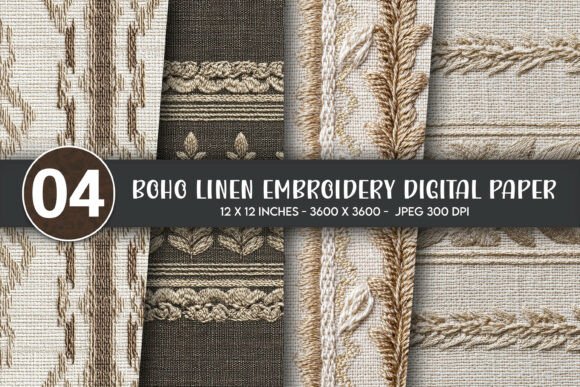
Boho Linen Embroidery Digital Paper
A Designer’s Real-World Review for Small Business Merchandise
As an embroidery designer who’s digitized over 2,000 logos and patterns for cafés, florists, bakeries, pet brands, and handmade studios, I approach every Boho Linen Embroidery Digital Paper with a dual lens: aesthetic harmony and commercial viability. This isn’t just wall art or a printable—it’s a machine embroidery design waiting to become your apron’s chest accent, your tote bag’s signature mark, or your staff cap’s subtle brand whisper. From first glance, Boho Linen Embroidery Digital Paper reads as warm, grounded, and intentionally imperfect—evoking linen texture, hand-stitched rhythm, and quiet confidence. It leans into the boho spirit without veering into clutter: think organic line weight, breathable negative space, and a rustic-elegant balance that feels both handmade and professionally curated.
Where Boho Linen Embroidery Digital Paper Shines in Business Use
This digital embroidery file thrives where authenticity meets wearability. For a local café launching branded staff aprons, Boho Linen Embroidery Digital Paper works beautifully as a left-chest patch—its open composition avoids bulk, its soft edges soften rigid cotton twill, and its earthy vibe reinforces artisanal coffee culture. On canvas tote bags for a boutique or florist, it scales cleanly from 3” to 5”, holding detail without overloading stitch density. As a sleeve detail on work shirts or a curved front cap design, its moderate line variation and forgiving silhouette adapt well—especially when paired with quality tear-away stabilizer and mid-weight thread colors like oatmeal, slate, or terracotta.
Small business owners on Etsy or at craft fairs will appreciate how Boho Linen Embroidery Digital Paper elevates perceived value: stitched onto greeting cards as a foil-accented appliqué, heat-set onto mug sleeves, or layered into custom packaging accents, it signals care and cohesion. It also serves double duty as a printable mockup base—use it in Canva or Adobe Illustrator to preview how your embroidered patch will sit beside your logo, typography, and color palette before stitching a single thread.
Smart Placement & Where to Proceed With Care
Not every surface is equal—and Boho Linen Embroidery Digital Paper rewards thoughtful placement. Avoid using it full-size on curved cap fronts under 2.5”; fine linework may blur or lose definition. Likewise, on dark uniforms (navy, charcoal, deep burgundy), verify thread color contrast early—what reads softly on cream linen can vanish on black twill without adjusted fill density or outline reinforcement. Tiny lettering or tight internal details? Not its strength. This is a Patterns-driven Graphics asset—not a typographic file—so lean into its textural flow, not precision micro-detail.
High stitch density areas (like dense botanical fills or overlapping stems) demand testing on your target fabric. Linen-blend canvas holds it well; thin jersey or textured burlap may require backing adjustments or simplified underlay. And if your small business merch includes items meant for frequent washing—think dog-walking apparel or bakery aprons—confirm the digital embroidery file uses balanced satin and fill stitches, not excessive run stitches that could snag.
Brand Identity Impact: More Than Just Pretty Stitching
Boho Linen Embroidery Digital Paper doesn’t just decorate—it communicates. Its tactile rhythm tells customers your brand values craftsmanship over flash. When stitched onto a handmade soap label or a ceramic studio’s packaging tag, it quietly affirms “this was made with attention.” That builds trust faster than any slogan. For creative studios and florists, it reinforces visual consistency across touchpoints: same motif on your Instagram story banner, your embroidered tote, and your thank-you card liner. That repetition breeds recognition—and recognition converts browsers into loyal buyers.
Crucially, it supports a handmade product narrative without looking amateurish. Unlike overly busy clipart or low-res downloads, this design carries the nuance of intentional spacing and organic scale—key markers of professional commercial embroidery. Customers subconsciously associate that polish with reliability, care, and brand maturity—even if they’ve never held an embroidery hoop.
Practical Designer Notes Before You Stitch
- Test in black and white first. Print a 1:1 grayscale version to assess contrast, spacing, and legibility—especially for patches under 3”.
- Check small-patch viability. Resize to your most common patch dimension (e.g., 2.25” wide) and inspect inner curves and junctions for stitch merging.
- Review thread color contrast on your actual fabric swatch—not just screen previews. Natural light changes everything.
- Inspect spacing between elements. Tight gaps may close up during stitching; allow ≥0.8mm clearance for clean separation.
- Confirm hoop size compatibility. If your smallest hoop is 4”x4”, ensure the design fits comfortably with margin for stabilizer pull.
- Test on real fabric—not just felt or practice cloth. Linen, canvas, and twill behave differently under needle tension.
- Use appropriate stabilizer. Medium-weight cutaway works best for structured items like caps and tote bags; tear-away suffices for stable cottons.
- Create a physical mockup for client approval—stitch one sample, photograph it in context (e.g., on a tote bag handle), and share before bulk production.
- Compare beside your other design assets. Does Boho Linen Embroidery Digital Paper harmonize with your logo, font system, and brand colors—or compete?
- Verify commercial licensing. Since this is intended for small business merch, custom apparel, and embroidered patch production, confirm the license permits resale and commercial embroidery use—don’t assume.
Bottom line: Boho Linen Embroidery Digital Paper is a versatile, brand-forward embroidery file—not a decorative afterthought. Used intentionally, it strengthens your brand identity, adds quiet prestige to everyday items, and helps your finished product feel thoughtfully stitched—not mass-produced. For embroidery shops, apparel decorators, and makers building something real, it’s less about what it looks like on screen—and more about how it lands, wears, and endures in the hands of your customers.